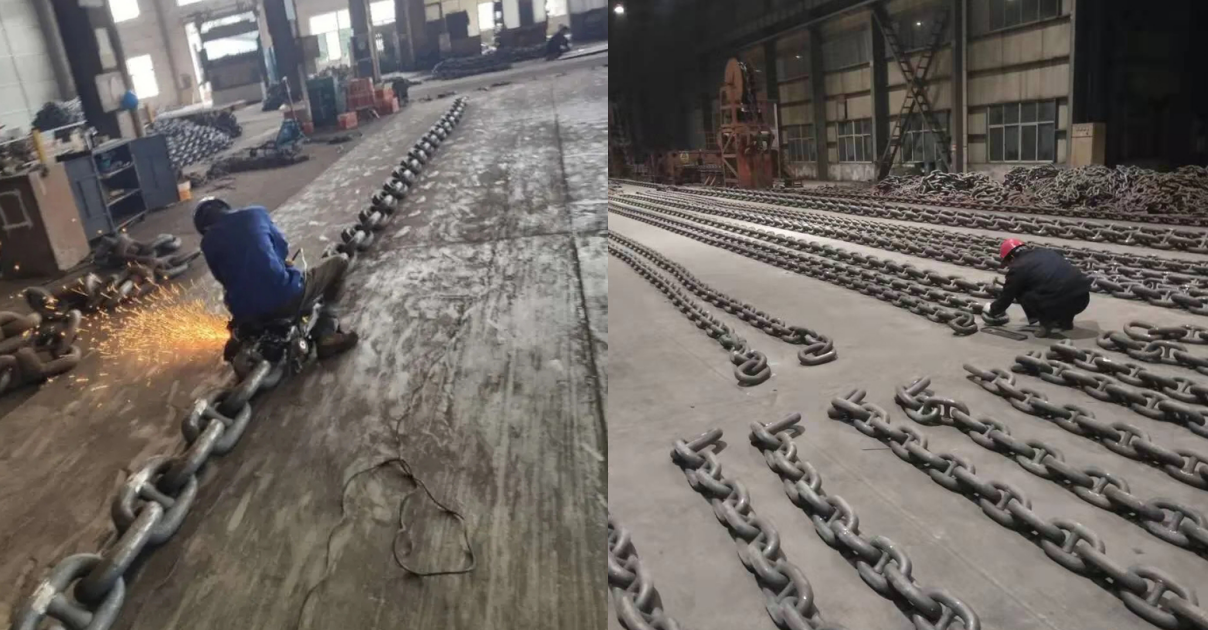
Introduction to the production process of marine anchor chains-Part 1
The production of carbon steel ship anchors is a highly specialized process that involves multiple precisely controlled manufacturing stages. From the selection of raw materials to the final product, it undergoes critical steps such as cutting, heating, forging, welding, heat treatment, quality inspection, and anti-corrosion treatment. Each stage must strictly adhere to international standards to ensure the strength, toughness, and corrosion resistance of the anchor chain.
I. Raw Material Preparation and Cutting
1. Steel selection
- Cast steel is chosen as the main material due to its excellent strength and corrosion resistance, which can meet the usage requirements of ships in harsh marine environments.
- The common steel specifications are 6-meter-long and 120-millimeter-diameter steel bars, and these steel bars arrive at the factory in the form of blocks of several tens of meters.
2. Precise Cutting
- Use a bridge crane to move large steel bars. Through an automatic saw, cut the steel bars into sections of the required length, each section weighing over 100 kilograms.
- The cutting process must ensure accuracy to provide raw materials of the appropriate specifications for the subsequent forging process.
II. Forging and Forming Processes
1. Heating treatment
- The cut steel sections are sent into the induction furnace and heated to above 1500℃. The scene inside the furnace resembles "a furious sunset", with the steel glowing a fiery orange color.
- The heating temperature needs to be precisely controlled, usually within the range of 530-600℃, to make the steel soft enough for shaping.
2. Forging Process
- The heated steel block is extracted using mechanical fixtures and placed in a hydraulic press that applies thousands of tons of force for forging.
- The steel is bent into the initial shape of a large chain link, and this process requires extremely precise measurement and experienced operators.
- Crossbar fabrication: The smaller-sized round steel is pressed through a forging equipment into a "small waist" shape, serving as the supporting structure in the middle of the anchor chain.
III. Welding and Assembly
1. Chain-link welding
- The bent chain-link interfaces are automatically welded. The electrodes press the joint together, and the current flows through the steel, generating resistance heat that melts the components into a complete solid.
- During the welding process, "beautiful iron sparks" are produced. After about 15 minutes, the sparks go out and the chain-link welding is completed.
2. Horizontal Installation
- Place the fabricated horizontal bar in the center of the anchor chain ring, start the press-fitting equipment to apply pressure, and deeply embed the horizontal bar into the anchor chain.
- The horizontal bar is firmly bonded to the anchor chain body through welding, ensuring the accuracy of the overall size and the stability of the shape of the anchor chain.