What Is the Difference Between Marine Bollards and Bitts?
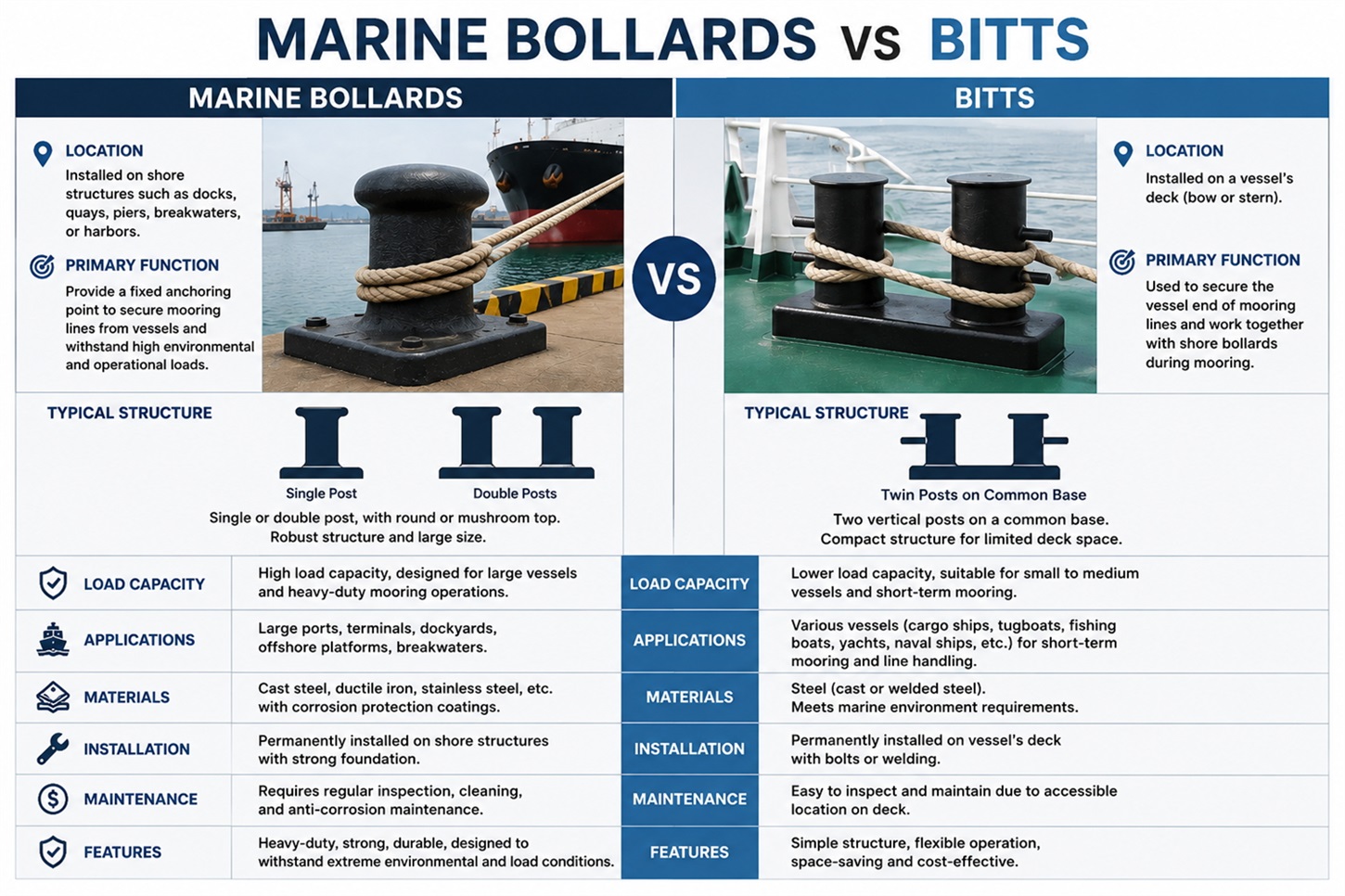
In marine mooring operations, the terms marine bollard and bitts are often used interchangeably. However, while both are essential mooring components, they serve different purposes and are designed for different applications.
Understanding the distinction between marine bollards and bitts is important for ship operators, port engineers, and marine equipment buyers. Choosing the right mooring equipment directly impacts vessel safety, operational efficiency, and long-term durability.
This article explains the key differences between marine bollards and bitts, including their structure, functions, installation locations, and load capacities.
What Are Marine Bollards?
Marine bollards are heavy-duty mooring fixtures permanently installed on shore-based structures such as:
-
Docks
-
Quay walls
-
Piers
-
Harbors
-
Breakwaters
Their primary function is to secure mooring lines from vessels and keep ships safely positioned alongside the berth.
Marine bollards are engineered to withstand extremely high mooring loads generated by:
-
Vessel movement
-
Wind forces
-
Waves and tides
-
Currents
-
Dynamic loading conditions
Because of their strength and durability, marine bollards are widely used in commercial ports, container terminals, shipyards, and offshore facilities.
What Are Bitts?
Bitts are a specific type of mooring fitting typically installed on a vessel’s deck, usually at the bow or stern.
Unlike shore-mounted marine bollards, bitts are shipboard mooring components designed to secure the vessel end of the mooring line.
A standard bitt usually consists of two vertical posts connected by a shared base. The crew wraps mooring ropes or cables around the bitts to hold the vessel securely during docking operations.
Bitts are commonly found on:
-
Cargo ships
-
Tugboats
-
Fishing vessels
-
Yachts
-
Naval ships
In simple terms:
-
Marine bollards are installed onshore
-
Bitts are installed onboard the vessel
This is the most fundamental difference between the two.
Structural Differences Between Marine Bollards and Bitts
Although both components are designed for mooring operations, their structural designs are significantly different.
Marine Bollards
Marine bollards are generally larger and heavier structures designed to handle substantial mooring forces.
Common characteristics include:
-
Single-post or double-post configurations
-
Rounded or curved tops for rope retention
-
Heavy-duty cast steel, ductile iron, or stainless steel construction
-
Corrosion-resistant coatings for marine environments
Their robust structure allows them to support large commercial vessels under high-load conditions.
Bitts
Bitts feature a more compact and simplified design.
Typical characteristics include:
-
Twin vertical posts mounted on a shared base
-
Smaller footprint for deck installation
-
Simpler rope securing arrangement
-
Steel construction suitable for onboard applications
Because they are installed on vessels where space is limited, bitts are generally smaller than marine bollards and designed for lower load capacities.
Functional Differences Between Marine Bollards and Bitts
Marine Bollards
Marine bollards serve as the primary shore-side anchoring point during mooring operations.
They are specifically designed for:
-
Long-term vessel mooring
-
Heavy-duty port applications
-
Large commercial ships
-
High-tension mooring conditions
Marine bollards are critical for maintaining vessel stability in harsh weather and demanding marine environments.
Bitts
Bitts are primarily used onboard vessels for handling and securing mooring lines.
They are ideal for:
-
Temporary berthing operations
-
Smaller vessels
-
Quick mooring procedures
-
Flexible rope handling onboard
Their simpler structure makes them easier to operate during routine docking and undocking activities.
Load Capacity Comparison
One of the biggest differences between marine bollards and bitts is their load-bearing capacity.
Marine Bollards
Marine bollards are designed to withstand extremely high tensile forces generated by large vessels.
They are commonly rated in tons and engineered for applications involving:
-
Cargo ships
-
Oil tankers
-
Container vessels
-
Offshore platforms
Their heavy-duty design ensures long-term reliability under continuous high-load conditions.
Bitts
Bitts are designed for comparatively lighter loads.
While still strong and durable, they are better suited for:
-
Small to medium-sized vessels
-
Short-term mooring
-
Routine docking operations
Their focus is on operational convenience rather than maximum load capacity.
How to Choose Between Marine Bollards and Bitts
Selecting the right mooring equipment depends on several operational factors.
Choose Marine Bollards If:
-
You operate a commercial port or terminal
-
Large vessels require secure long-term mooring
-
High mooring loads are expected
-
Harsh marine conditions are common
-
Maximum structural strength is required
Choose Bitts If:
-
The application is onboard vessel mooring
-
Space is limited
-
Quick mooring operations are needed
-
Smaller vessels are involved
-
Flexible rope handling is important
Cost and Maintenance Considerations
Marine bollards are typically more expensive due to:
-
Larger structural size
-
Higher-grade materials
-
Greater load requirements
-
More complex installation
However, they also provide longer service life and improved safety performance for demanding marine operations.
Bitts are generally more economical and easier to maintain because of their simpler design and smaller size.
Conclusion
Although marine bollards and bitts both play important roles in mooring operations, they are designed for different environments and functions.
Marine bollards are heavy-duty shore-based mooring fixtures built for securing large vessels under high-load conditions. Bitts, on the other hand, are compact shipboard fittings used for securing mooring lines onboard vessels.
Understanding these differences helps improve mooring safety, operational efficiency, and equipment selection for marine applications.
In summary:
-
All bitts can be considered a type of bollard
-
Not all bollards are bitts
Choosing the right mooring equipment ultimately depends on vessel type, operational requirements, and environmental conditions.